Edge AI moves intelligence from the cloud to local devices, enabling systems that can react quickly and keep data close to where it is produced. However, communication becomes a bottleneck when many devices must share information. Over-the-Air Computation (AirComp) addresses this problem by using the natural superposition of radio waves to compute while data is being transmitted. The physical signal therefore carries not only data, but also the result of a shared computation.
The Rise of Edge AI
Edge AI moves computation from centralized cloud platforms to the devices that generate the data. Instead of continuously transferring raw information to a distant server, Edge Devices (EDs) can process it locally and send only the results that are needed. This reduces latency, network traffic, energy consumption, and the exposure of private information [1].
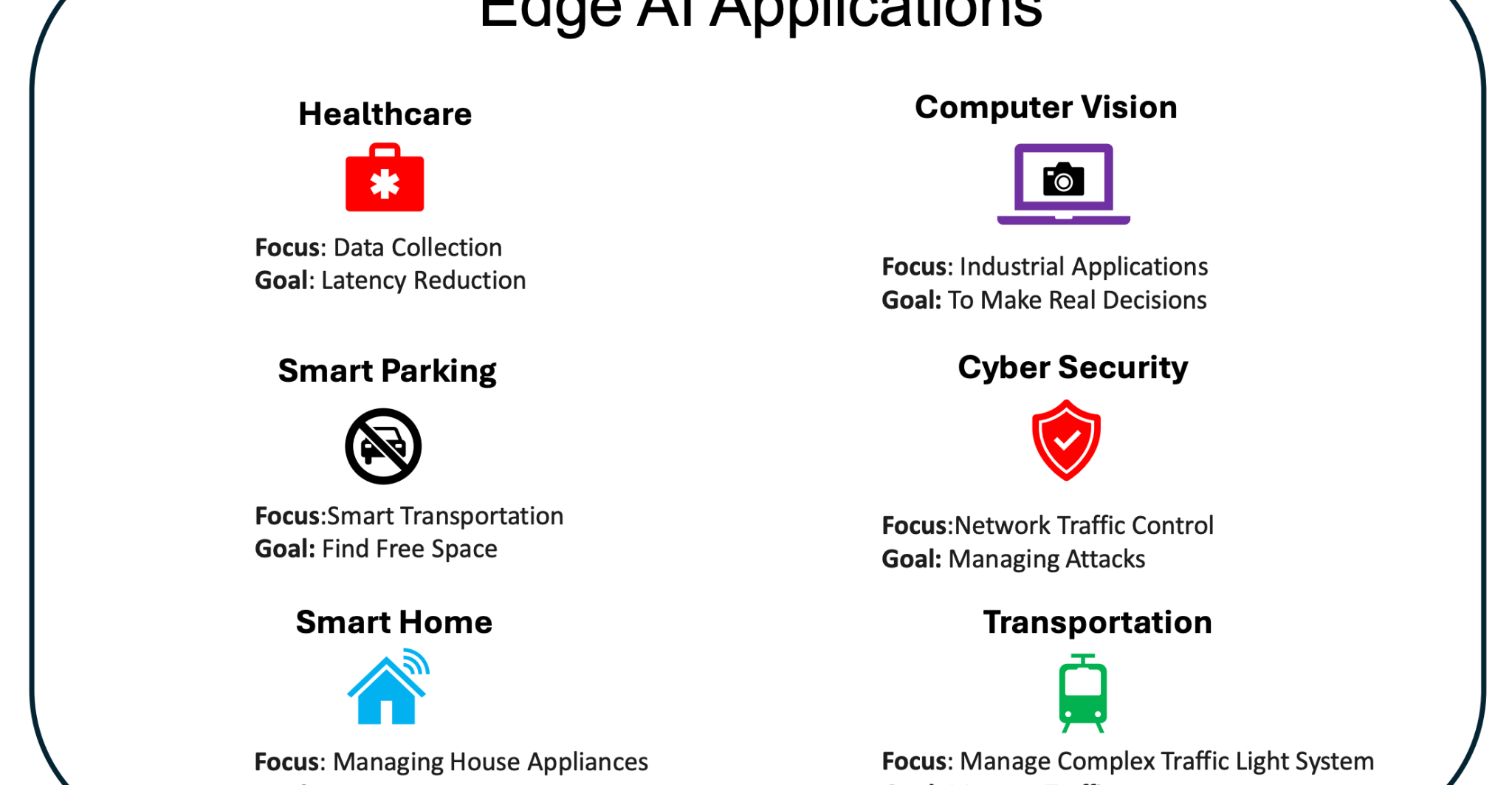
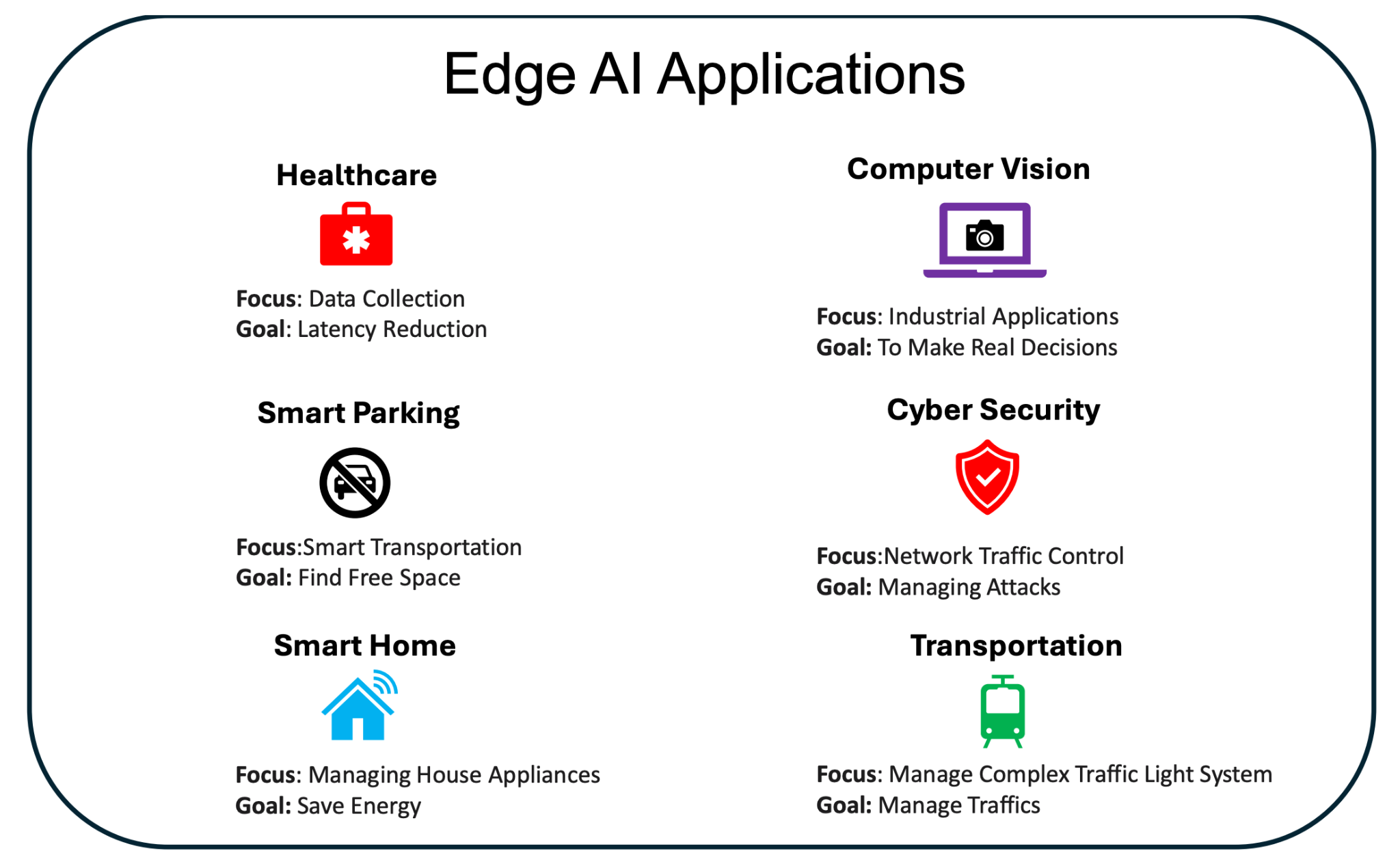
As shown in Figure 1, Edge AI supports a wide range of applications, including healthcare, computer vision, cybersecurity, smart homes, smart parking, and intelligent transportation. These applications often need to process sensor data and make decisions with very low delay.
The same applications also introduce important constraints. EDs may have limited memory, processing power, battery capacity, and network access. In addition, systems such as vehicle networks, robot teams, and distributed sensor networks may contain many EDs that must coordinate with an Edge Server (ES).
Local processing solves part of the problem, but the EDs still need to exchange results. As the number of participating devices grows, communication can become slower and more expensive than the local computation itself.
The Communication Bottleneck
Conventional wireless systems avoid signal collisions by separating users in time, frequency, or code. Each ED receives its own communication resource, and the ES decodes every message separately before performing the required computation [2].
If K EDs participate, the required communication time or bandwidth generally grows with K. This linear scaling creates a serious bottleneck when many devices must contribute to the same result.
For example, consider a group of autonomous vehicles or drones that must quickly agree on the location of an obstacle. If every vehicle must wait for an individual transmission slot, the final decision is delayed as more vehicles join the network. In a fast-changing environment, an outdated decision may no longer describe the current position of the obstacle.
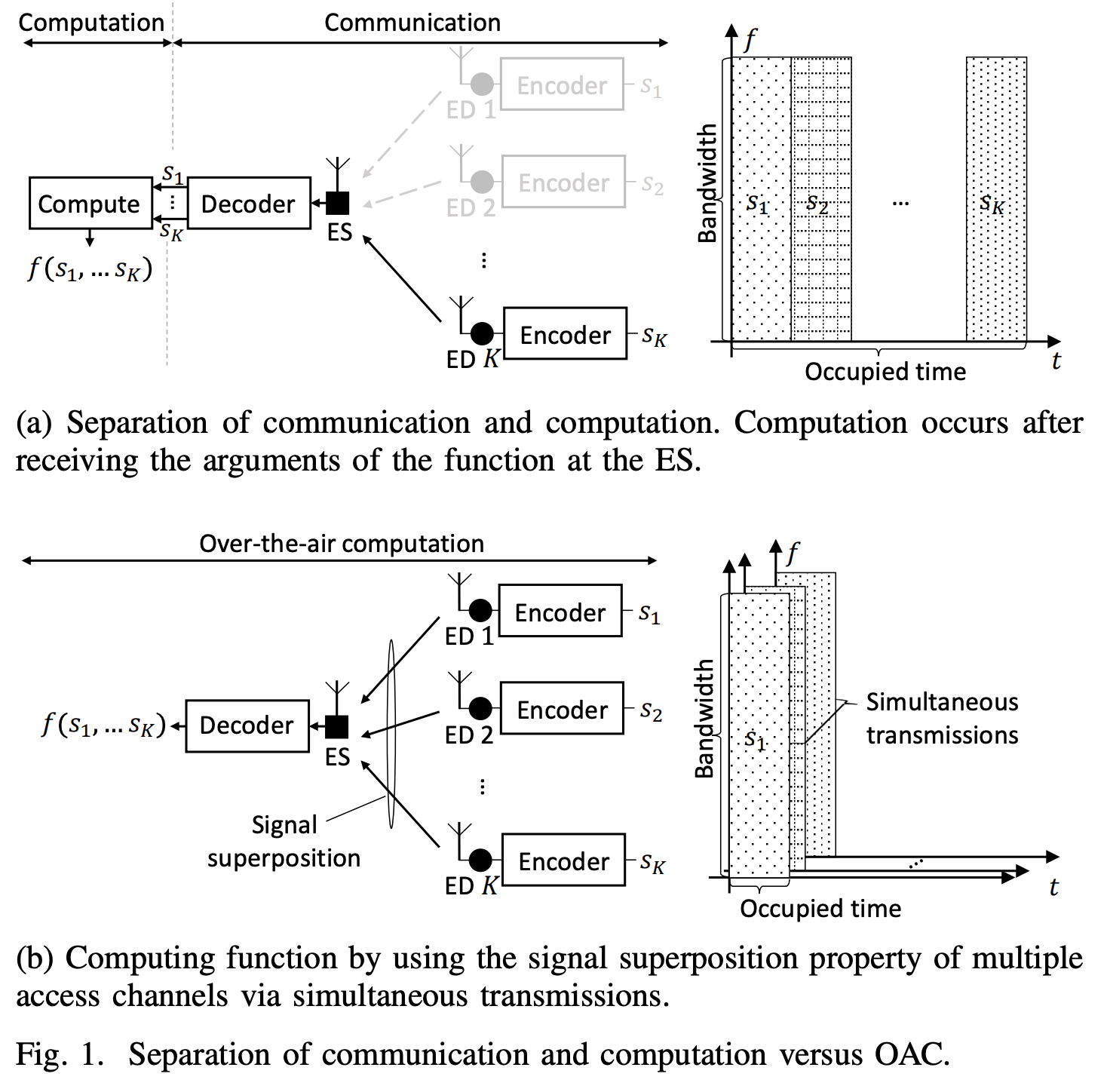
Figure 2 shows this problem in the bandwidth–time resource plane. The vertical axis represents occupied bandwidth, while the horizontal axis represents occupied time. In the upper scheme, the encoders at ED1 through EDK transmit the local values s1, s2, …, sK separately. The ES decoder must recover every value before computing the target function f(s1, …, sK).
Therefore, large Edge AI systems need a better approach: one that does not collect every value separately, but instead calculates the required result in one shared transmission interval, largely independent of the number of participating devices.
The Solution: Making the Signal Become the Computation
The lower scheme in Figure 2 shows the AirComp approach. All EDs transmit simultaneously over the same time and frequency resources. Their radio waves naturally add in the wireless multiple-access channel, and the ES receives one combined signal representing the desired aggregate [2].
Each ED first applies a pre-processing function to its local value. This may include weighting, normalization, sign extraction, or compensation for changes in amplitude and phase caused by the wireless channel. The encoder then maps the processed value to a transmit signal.
The ES receives the superposition of all transmitted signals together with noise. Its decoder applies a post-processing function to remove known scaling and recover an estimate of the target result.
AirComp therefore follows three main steps:
Pre-processing at each ED → Wireless superposition → Post-processing at the ES.
AirComp can directly compute only nomographic functions. These are functions that can be represented through separate transformations of the local values, followed by addition and a final transformation at the ES. Examples include sums, averages, weighted averages, and majority votes. Functions without a suitable nomographic representation cannot be computed directly using basic AirComp.
The main improvement is scalability. Conventional communication handles ED transmissions separately, so its resource use grows approximately linearly with the number of EDs. AirComp performs the aggregation in one shared transmission interval. Compared with sequential transmission, the result is obtained almost immediately and the required aggregation time remains largely independent of the number of participating EDs.
This does not mean that AirComp is free of delay or error. Its accuracy depends on synchronization, Channel State Information (CSI), channel compensation, transmit-power limits, and receiver noise. Even so, the physical signal performs part of the computation before it reaches the ES.
The Synergy: AirComp for Distributed Learning
Federated Learning (FL) is a natural application of AirComp. In FL, EDs train a shared model using local datasets and send model updates to an ES. The ES aggregates these updates to create the next global model without collecting the original training data [3].
Figure 3 shows this process. Each selected ED produces a local model update, represented by z1, z2, …, zM, and sends it to the central Base Station. In this context, the Base Station performs the same aggregation role as the ES, so the two terms are equivalent.
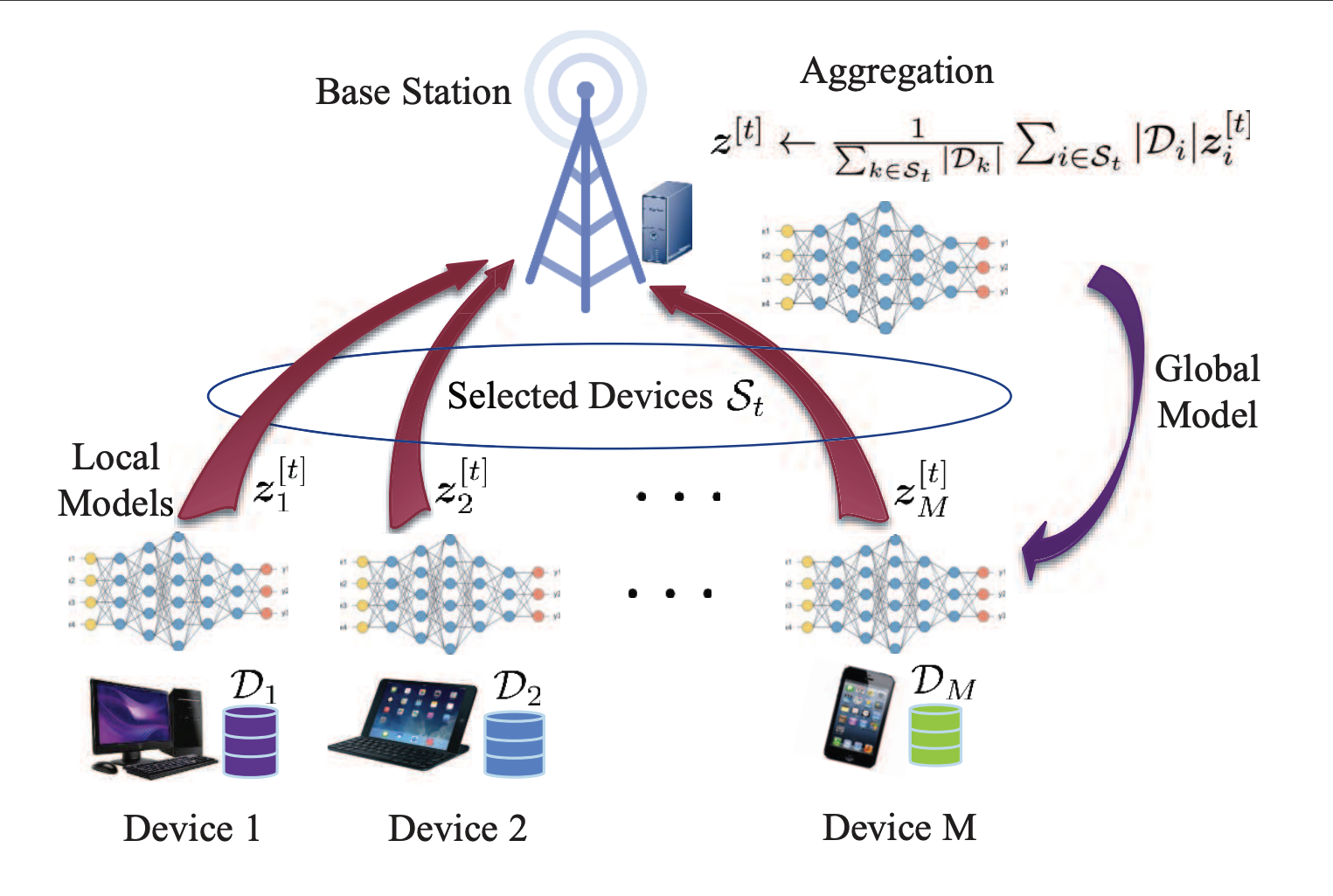
With conventional communication, the ES receives and decodes each model update separately. With AirComp, each ED pre-processes its update by applying the required aggregation weight. The EDs then transmit simultaneously, and the superimposed signal represents their weighted sum. The ES applies post-processing to obtain the model average.
The wireless channel therefore becomes part of the learning algorithm. This reduces communication time, but poor synchronization, weak channels, or noise can distort the aggregated model update. Device selection and wireless processing must therefore be designed together with the learning method [3].
From Theory to Hardware
AirComp has been demonstrated using affordable Software Defined Radios (SDRs). Figure 4 shows a practical Federated Edge Learning testbed with one ES and five ED radios based on ADALM-Pluto hardware [4].
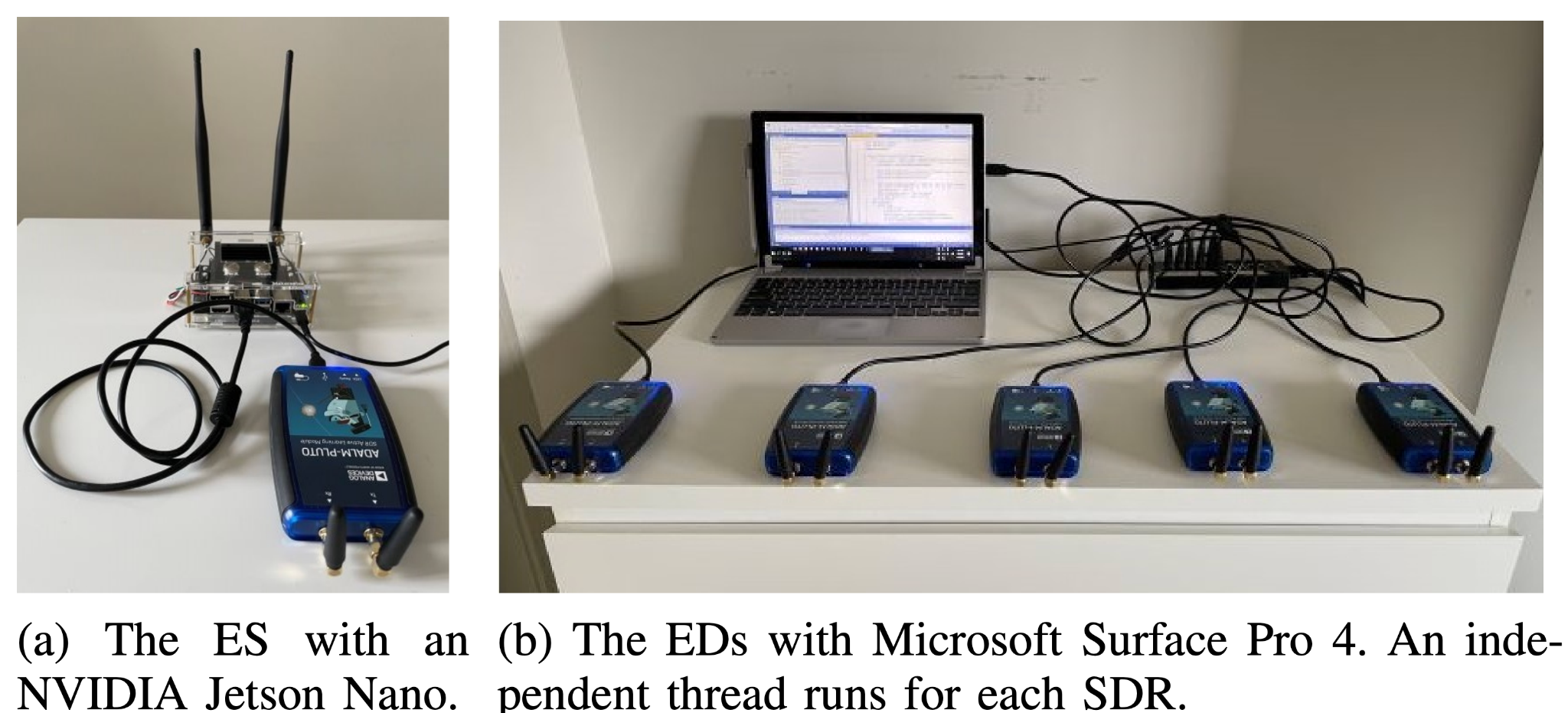
The testbed used Frequency-Shift Keying Majority Vote (FSK-MV). Each ED converted its local learning update into a vote and transmitted it over shared radio resources. The ES detected the majority directly from the superimposed signal instead of decoding every vote separately.
The system also used hardware-level synchronization to reduce timing errors caused by USB communication, operating-system scheduling, and software execution. This demonstrated that AirComp can operate on real hardware under practical wireless constraints [4].
How AirComp Will Shape Our Future
AirComp changes wireless networks from systems that only transport data into systems that can also process it. By combining local pre-processing, physical signal superposition, and ES post-processing, the network can produce useful information while communication is taking place.
Our work focuses on implementing this principle on hardware-constrained EDs. These devices require simple pre-processing functions, efficient encoders and decoders, careful memory use, accurate synchronization, and intelligent selection of participating devices.
A practical example is crowd counting for obstacle avoidance. Several EDs, such as cameras or wireless sensors, can locally estimate the number of people detected in different areas. Instead of transmitting every estimate separately, the EDs can use AirComp to send them simultaneously. Their signals combine in the air, allowing the ES to obtain the total or average crowd density in one shared transmission. A robot, drone, or autonomous vehicle could then use this result to avoid crowded areas or select a safer route.
Other potential applications include environmental monitoring, collaborative decision-making, and FL. In each case, the goal is not to recover every local value, but to obtain a shared function of those values as efficiently as possible.
AirComp will not replace conventional wireless communication when individual messages must be recovered exactly. However, when a system needs a nomographic function of many local values, allowing the physical signal itself to carry the computation can remove a major communication bottleneck and enable more scalable Edge AI systems.
References
[1] Sukhpal Singh Gill et al. “Edge AI: A Taxonomy, Systematic Review and Future Directions”. Cluster Computing 28 (2025), pp. 11953–11981. doi: 10.1007/s10586-024-04686-y.
[2] Alphan Şahin and Rui Yang. “A Survey on Over-the-Air Computation”. IEEE Communications Surveys & Tutorials 25.3 (2023), pp. 1877–1908. doi: 10.1109/COMST.2023.3264649.
[3] Kai Yang et al. “Federated Learning via Over-the-Air Computation”. IEEE Transactions on Wireless Communications 19.3 (2020), pp. 2022–2035. doi: 10.1109/TWC.2019.2961673.
[4] Alphan Şahin. “A Demonstration of Over-the-Air Computation for Federated Edge Learning”. 2022 IEEE Globecom Workshops, pp. 1821–1827. doi: 10.1109/GCWkshps56602.2022.10008778.